


Tracker: Employment Rights Act
The Employment Rights Act will make significant reforms changes to many aspects of employment law.

Explore the Employment Rights Act Hub
This article forms part of our dedicated Employment Rights Act Hub, bringing together the latest legal updates, implementation tracker, practical guidance and resources across every key reform. Explore the wider picture and stay informed as the changes continue to develop.
Last updated 25 September 2026
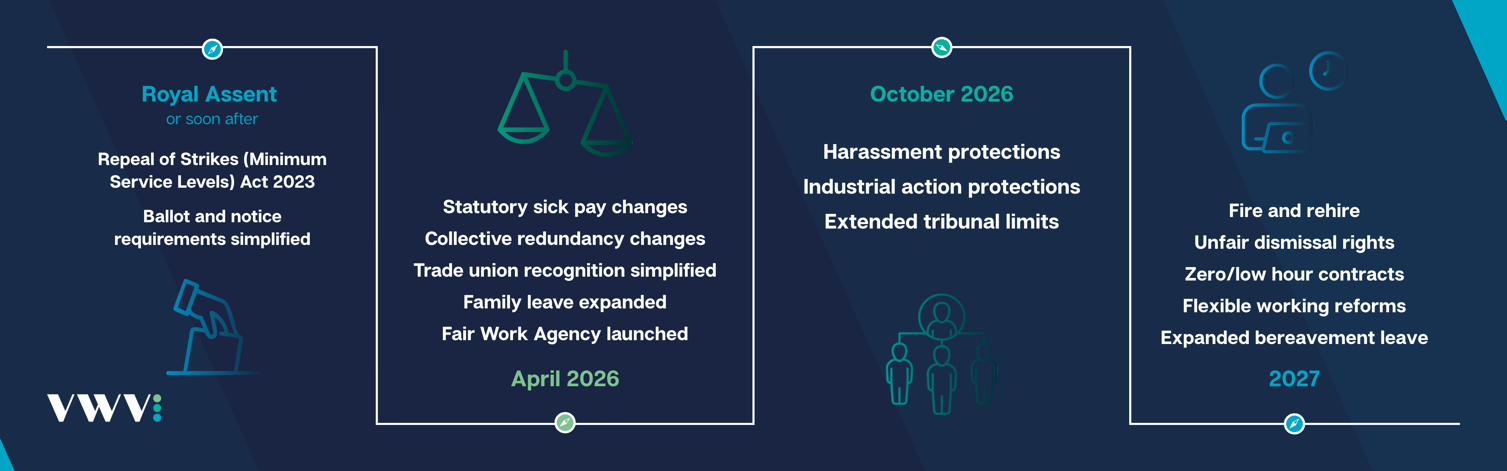
The government initially published its implementation roadmap in July 2025, confirming that the Employment Rights Act will be introduced in phases, with commencement dates grouped around April 2026, October 2026, January 2027 and later 2027.
Key milestones are as follows:
At Royal Assent the Strikes (Minimum Service Levels) Act 2023 was repealed.
18 February 2026 changes included:
The repeal of the great majority of the Trade Union Act 2016, including in relation to industrial action and political funds
Removing the 10-year ballot requirement for trade union political funds
Simplifying industrial action notices and industrial action ballot notices
Protections against dismissal for taking industrial action
Employees that are newly eligible for ‘Day 1’ Paternity Leave and Unpaid Parental Leave can give notice
April 2026 changes included:
Collective redundancy protective award – doubling the maximum period of the protective award
‘Day 1’ Paternity Leave and Unpaid Parental Leave
Whistleblowing – strengthening protections for workers who ‘blow the whistle’ on sexual harassment
Bereaved Partners’ Paternity Leave – (non-MWP measure) will enable bereaved fathers and partners to take up to 52 weeks of paternity leave if the mother or primary adopter dies within the first year of the child’s life
Statutory Sick Pay (SSP) – removing the Lower Earnings Limit (LEL) and waiting period
Action plans on gender equality and supporting employees through the menopause (voluntary)
Menopause guidance
Simplifying trade union recognition process
The establishment of the Fair Work Agency
On 25 August 2026:
Electronic and workplace balloting for Statutory Trade Union Ballots will be introduced
On 1 October 2026:
Employment tribunal time limits will be extended from three to six months. (For breach of contract claims in Scottish employment tribunals, the change will take effect on 9 November 2026)
On 30 October changes will include:
Protection against all forms of detriment for taking industrial action
Strengthening trade unions’ right of access
Unfair practices in the trade union recognition process and all remaining trade union recognition measures, including freezing the bargaining unit when an application is received
New rights and protections for trade union representatives
Requiring employers to take ‘all reasonable steps’ to prevent sexual harassment of their employees
Introducing an obligation on employers not to permit the harassment of their employees by third parties
Introducing a power that will enable the minister to make regulations at a later date, specifying evidence-based steps which employers must take to prevent sexual harassment (this will complement not replace the broader legislative requirement to take all reasonable steps)
From a currently unknown date in October 2026, key measures will include:
Bringing forward regulations to establish the Fair Pay Agreement Adult Social Care Negotiating Body in England
The following measures will take effect in January 2027:
The duty to inform workers of their right to join a trade union
Reduction of unfair dismissal qualifying period to 6 months, for dismissals from 1 January 2027, and uncapping compensatory awards
Fire and rehire protections
The following measures will take effect by end of 2026:
Strengthening tipping law
The following measures will take effect at some point in 2027:
Action plans on gender equality and supporting employees through the menopause (mandatory)
Enhanced dismissal protections for pregnant women and new mothers
Extending blacklisting protections
Industrial relations framework
Regulation of umbrella companies
Collective redundancy – collective consultation threshold
Flexible working
Bereavement leave including pregnancy loss
Introduction of the right to guaranteed hours and the right to reasonable notice and short notice payments (timings will be updated after consultation)
Electronic and workplace balloting for recognition and derecognition ballots
The ban on NDAs in relation to workplace discrimination and harassment.
Royal Assent and Shortly After
Repeal of minimum service levels legislation
The Act repeals the Minimum Service Levels legislation, established by the last government, which required trade unions and employers in key sectors (such as health, transport, and education) to agree on minimum staffing levels during strikes.
The repeal of the Minimum Service Levels legislation came into effect on Royal Assent (18 December 2025).
Balloting and picketing
The Act repeals most provisions of the Trade Union Act 2016, reducing restrictions on trade union activities. The 40% support threshold in important public services was removed on 18 February 2026.
However, the 50% turnout threshold will remain in place for now. Its removal has been paused and pending the introduction of electronic balloting (see "Turnout threshold for industrial action ballots" for more information on this).
Trade unions will no longer need to adhere to reporting requirements for industrial action, such as providing detailed information on ballot papers or including industrial action details in annual returns to the Certification Officer. There will be a 10 day notice period for industrial action.
Picketing rules that required an appointed supervisor will be repealed. Additionally, public sector employers will no longer need to publish facility time information, nor will ministers have the power to cap facility time. Payroll deductions for union subscriptions in the public sector will no longer need to be funded by unions.
The validity of a trade union's legal mandate for industrial action will be extended from 6 months to 12 months.
The majority of the Act’s balloting and picketing reforms (including repeal of most provisions of the Trade Union Act 2016, changes to reporting requirements, public sector facility time provisions, and the extension of the mandate period for industrial action ballots from 6 to 12 months) came into force two months after Royal Assent(18 February 2026).
Contributions to political funds
The Act changes how trade union members contribute to political funds. Under current law, trade union members must actively opt in if they wish to contribute to a union’s political fund. Under the Act, this position will be reversed.
The Act will require trade unions to treat members as contributors to political funds by default, unless the member opts out. This reinstates an opt-out model, under which union members will no longer need to give express consent to make political fund contributions.
The Act also refines the process for when opt-out notices take effect. An opt-out notice will take effect from 1 January following the year in which the notice is given, or on an earlier date specified in, or determined in accordance with, the trade union’s rules, whichever of those dates comes first.
Before the Act was passed, there was debate between the two Houses about when an opt-out notice should take effect. Ultimately a compromise was reached by placing a statutory duty on the government to issue guidance within three months of the clause coming into force. This guidance will set out the types of provision trade unions should include in their rules when determining how and when opt-out notices take effect.
This change came into force on 18 February 2026.
The Act strengthens protections for workers participating in industrial action. It introduces a prohibition on detrimental treatment (and dismissal) aimed at deterring or penalising workers for engaging in protected industrial action, with the scope of prohibited detriments to be defined in future regulations. The Act also removes the current 12-week cap on protection against unfair dismissal, ensuring that employees remain protected for the entire duration of a protected strike.
The extended dismissal protection came into force on 18 February 2026.
The detriment provisions will come into force on 30 October 2026 and will apply to all types of detriment imposed for the sole or main purpose of penalising, preventing or deterring industrial action.
April 2026
Under the current system, employees must meet certain length-of-service requirements to qualify for parental and paternity leave. The Act removes these qualification periods, allowing employees to access these rights from their first day of employment.
This change came into force on 6 April 2026.
The Act removes the current restriction preventing employees from taking paternity leave and pay after shared parental leave and pay.
This change came into force on 6 April 2026.
Removal of SSP waiting days
The Act removed the current three-day waiting period before statutory sick pay (SSP) kicks in. This means that SSP is now payable from the first sick day rather than the fourth.
Removal of lower earnings limit
The Act removed the lower earnings limit for the payment of SSP. The weekly rate of SSP is now the lower of the prescribed weekly rate (£118.75 from 6 April 2026) and 80% of the employee's normal weekly earnings.
Commencement
These changes came into effect on 6 April 2026.
Creation of the Fair Work Agency
The Act establishes a new enforcement body, the Fair Work Agency, which will consolidate the functions of the Gangmasters and Labour Abuse Authority (GLAA), the Employment Agency Standards Inspectorate (EAS), and the National Minimum Wage and statutory payments enforcement teams currently operated by HMRC. The Secretary of State will assume the enforcement powers currently held by those agencies.
The Government has confirmed that the new Agency will be well-resourced and have stronger powers to address serious labour exploitation. It will also be able to support workers who may be reluctant or unable to bring claims themselves. Regulations will provide further detail on how the FWA will operate in practice, including how it will work alongside other enforcement bodies such as the Equality and Human Rights Commission.
Holiday pay enforcement
The enforcement powers of the new Agency will include the ability to investigate breaches of the Working Time Regulations 1998, including in respect of holiday pay.
Employers must maintain adequate records to demonstrate compliance with the rights awarded by the Working Time Regulations 1998, including:
- The requirement to give workers the correct amount of annual leave;
- The obligation to make the correct payments for leave; and
- The requirement to make a payment for unused statutory leave when the contract terminates (including for any leave which the employee or worker was legally entitled to carry forward from the previous holiday year).
Failure to comply with the duty will be a criminal offence. The FWA will have the power to demand any underpayment and impose a 200% penalty on any underpayment, capped at £20,000 per individual. The FWA will commence enforcement of this in 2027, however, the duty to maintain records applies from 6 April 2026.
Warrants to enter premises
Inspectors will be able to enter business premises; and private dwellings used for work purposes; provided they obtain a warrant.
Notices of underpayment
The Act introduces powers for the Secretary of State to issue notices of underpayment to employers who fail to pay statutory entitlements. Employers will be required to repay the outstanding sum within 28 days. If they fail to do so, penalties of up to 200% of the underpaid amount (capped at £20,000 per individual) may apply. Notices may be appealed, and provisions exist for withdrawal or correction of errors. Penalties may be suspended if criminal proceedings are pending in relation to the same matter.
Civil proceedings on behalf of workers
The Secretary of State will have the power to bring Employment Tribunal proceedings on behalf of workers who are unlikely to take action themselves, although this will not apply in cases involving notices of underpayment or specific agricultural rights. Where such proceedings are brought, the Secretary of State may also provide legal advice or representation, with costs recoverable from any awarded sums.
Commencement
The FWA will be established in phases, with the body established on 7 April 2026 and its enforcement functions and powers taking effect gradually.
Whistleblowing protection for sexual harassment disclosures
It will now be a protected disclosure for a worker to report that sexual harassment has occurred, is occurring or is likely to occur. This will make it clearer that staff who complain of sexual harassment will be protected from detriment and dismissal under the whistleblowing framework.
This change took effect on 6 April 2026.
The Act simplifies the statutory union recognition process. The requirement for unions to demonstrate that a majority of workers in the bargaining unit are likely to support recognition at the application stage will be removed. The current 10% membership threshold will remain, but the government will have the power to adjust this to a level between 2% and 10% via secondary legislation.
In recognition ballots, the existing requirement for both a majority of votes cast and support from at least 40% of the bargaining unit will be removed. Going forward, a simple majority of those voting will be sufficient for recognition.
These provisions came into force on 6 April 2026.
Protective award changes
Currently, employers may be required to pay a protective award of up to 90 days’ pay per affected employee if they fail to follow redundancy consultation rules. The Act increases the protective award to 180 days' pay per employee, allowing tribunals more discretion to make higher awards. This came into force on 6 April 2026.
The government also consulted on whether interim relief should be available to employees who claim a protective award. The government has decided that this would not be an effective remedy at present and these proposals will not be taken forward.
August 2026
The Act commits to introducing secure electronic balloting for trade union votes, with full implementation planned after the launch of a working group. This follows a consultation and review involving stakeholders, including cybersecurity experts and trade unions.
The Code of Practice on Electronic and Workplace Balloting for Statutory Union Ballots will come into force on 25 August 2026.
Electronic balloting is expected to come into force no earlier than August 2026 for Statutory Trade Union Ballots, and some time in 2027 for recognition and de-recognition ballots.
Key dates and events
19 November 2025: Electronic balloting consultation opens
28 January 2026: Electronic balloting consultation closed
25 October 2026: The Code of Practice on Electronic and Workplace Balloting for Statutory Union Ballots, and the legislation permitting electronic and workplace voting for statutory trade union ballots will come into force.
October 2026
The Act expands the current duty on employers to take reasonable steps to prevent the workplace sexual harassment of staff. Employers will instead be required to take "all" reasonable steps to prevent such harassment.
The Act also sets out the power for the Secretary of State to make regulations specifying the steps employers must take in order to comply with their harassment prevention duties.
This change will take effect on 30 October 2026.
The Act will make employers liable for the acts of third parties who harass staff, unless the employer takes all reasonable steps to prevent such harassment.
It is important to note that this liability for third-party harassment will apply to all types of harassment, and not just sexual harassment. In addition, the government has clarified that the new liability will apply even to isolated incidents, including overheard remarks, provided it would be reasonable to expect the employer to have taken preventive steps in the circumstances.
There will be no automatic exemption based on a lack of prior knowledge.
This change will take effect on 30 October 2026.
The Act extends the limitation date to bring all types of employment tribunal claim, from three to six months. This will take effect on 1 October 2026.
The Act provides a framework for "qualifying" trade unions to negotiate access agreements with employers. Qualifying trade unions are trade unions with a certificate of independence.
Access agreements will allow unions to access workplaces for purposes such as recruitment, organising members, and facilitating collective bargaining. Access includes both physical access and digital communication with workers (for example, via intranet or email) and employers will not be able to refuse one form of access solely because the other is available. Further details on how this will operate in practice will be set out in regulations, following consultation.
If employers and unions fail to agree on access terms, the Central Arbitration Committee (CAC) will determine the terms of access. The CAC will also have enforcement powers to address breaches of access agreements and impose penalties where necessary. Access agreements will not be legally enforceable contracts and may only be enforced through the CAC complaint process.
The Act also contains the power for the Secretary of State to pass regulations setting out the circumstances in which it will be reasonable for the CAC to make a determination that a union's access request can be rejected. The government will also use secondary legislation to provide the CAC with a framework for fines to be issued for non-compliance with the right of access.
The government has published its response to the consultation and launched a further consultation on a new draft Code of Practice.
These provisions will come into force on 30 October 2026.
Key dates and events
23 October 2025: Consultation opens on the right of trade unions to access workplaces
18 December 2025: Consultation closes
8 April 2026: Consultation response published and a further consultation opened on the new draft Code of Practice.
10 July 2026: Consultation response published with updated draft Code of Practice published laid before Parliament for approval
30 October 2026: Right of access scheduled to come into force
The Act strengthens the right to reasonable paid facility time by creating a presumption in favour of the union representative’s view of what is reasonable. Employers will need to prove otherwise if they dispute the representative’s assessment. It also introduces a statutory requirement for employers to provide union representatives with access to workplace facilities, such as office and meeting space, to support their duties.
The Act establishes a new right for trade union equality representatives to take reasonable time off to promote workplace equality, arrange training, provide advice, and consult with employers on equality matters.
These provisions will come into force on 30 October 2026.
Key dates and events
20 January 2026: Consultation opens on a draft updated Code of Practice for time off for trade union duties and activities.
17 March 2026: Consultation closes
10 July 2026: Draft Code of Practice published and laid before Parliament for approval.
The Act aims to protect workers in public sector outsourcing arrangements, by introducing powers to pass regulations ensuring that outsourced workers are treated fairly.
Relevant outsourcing contracts
A "relevant outsourcing contract" is defined as a contract that involves the supply of services previously performed by a public contracting authority. It also applies to framework agreements facilitating such contracts. Workers covered under these provisions, referred to as "transferring workers," are individuals performing functions under the outsourcing contract who were previously employed by the contracting authority in similar roles. The protections extend to ensuring these workers are not treated less favourably by the new supplier or subcontractors than they were by the contracting authority.
Obligations and protections
The Act grants the power for the Secretary of State to pass regulations requiring specific provisions in relevant outsourcing contracts. The provisions must ensure that transferring employees are treated no less favourably than they were as employees of the contracting authority, and that workers who are not transferring workers are treated no less favourably than transferring workers.
Contracting authorities must take reasonable steps to ensure these provisions are included in relevant contracts and must also work to secure compliance. A mandatory code of practice will provide guidance to contracting authorities on ensuring fair treatment of workers during outsourcing, which must be published and adhered to by relevant authorities.
Commencement
These provisions have not come into force immediately. Instead, they will require further substantive regulations to be made, meaning their implementation could be delayed until the necessary secondary legislation is introduced.
January 2027
The Act introduces a new duty on employers to give workers a written statement informing them of their right to join a trade union. The government will provide standardised wording, which employers will only be able to amend to add workplace-specific information. The statement will explain union functions and relevant statutory rights and, where applicable, give information about recognised unions and statutory access agreements. Employers must also include a link to the Certification Officer’s list of trade unions or provide a copy alongside the statement.
New workers must receive the statement directly at the same time as their written statement of employment particulars. For existing workers, employers may provide it directly each year by 5 April. Alternatively, they may make it continuously and reasonably accessible, provided they tell workers where to find it and send an annual reminder. Employers using this alternative must tell workers directly if the statement’s location changes. A change to the identity of a union with a recognition or statutory access agreement will require the statement to be reissued within one month.
Failure to provide the statement will be treated in the same way as failure to provide a written statement of employment particulars. The detailed requirements and standardised wording remain subject to regulations. The government’s latest implementation timetable places commencement in January 2027, while its consultation response describes the intended window as December 2026 to January 2027. The exact date has not yet been confirmed.
Key dates and events
20 January 2025: TULR(C)A Amendment Order 2025 comes into force
4 March 2025: Government publishes response to "Making Work Pay: creating a modern framework for industrial relations"
1 July 2025: Implementation roadmap published, confirming commencement timescales for these provisions
23 October 2025: Consultation opens on the duty to inform workers of their right to join a trade union
18 December 2025: Consultation closes
25 September 2026: Government publishes its consultation response and an updated implementation timetable
Six-month unfair dismissal qualifying period
The current two-year qualifying period for ordinary unfair dismissal will be reduced to six months with effect from 1 January 2027. This means that new hires commencing employment from July 2026 onwards will have a six-month qualifying period.
Removal of cap on compensatory awards
The statutory cap on compensatory awards for unfair dismissal will also be removed from 1 January 2027. This will remove both the 52 weeks' salary cap, as well as the overall statutory cap. This will mean that claimants will be able to claim potentially unlimited compensation for ordinary unfair dismissal claims.
Further reading
Read our article for more information on the latest government position on the unfair dismissal qualifying period.
Automatic unfair dismissal
The Act makes fire and re-hire dismissals (otherwise known as "dismissal and re-engagement") automatically unfair if the reason for dismissal is that:
The employer sought to vary the employee's contract of employment to make a "restricted variation"
The employee did not agree to the variation.
What is a "restricted variation"?
A “restricted variation” means any of the following:
Reduction of pay
Where pay relates to the amount of work done, a variation of that measure
A variation of any term or condition relating to pensions or pension schemes
Variation of hours
Variation to timing or duration of shift
Reduction in amount of time off the employee is entitled to take
A variation specified in Regulations
A variations clause in a contract of employment which enables the employer to make any of the above changes without the employee’s agreement
Notably, variations to place of work and employee duties do not appear to count as a "restricted variation"
When will fire and re-hire be possible?
Where there is a restricted variation, employers will be able to justify the dismissal of an employee for refusing to agree to contractual changes where the employer can demonstrate:
An essential business need: that the proposed contractual changes were essential to avoid substantial financial harm to the business which were affecting or were likely "in the immediate future to affect" the employer's ability to carry on its business
Exhaustive efforts: that in the circumstances the employer could not reasonably have avoided the need to make the variation.
Where there is not a restricted variation, the Tribunal can still consider the fairness of the dismissal and will take into account the reason for the variation, any consultation that has taken place, anything offered in return for agreeing to the variation, and any matters specified in regulations.
Ban on replacing employees with individuals who are not employees
The Act also abolishes "fire and replace" dismissals: where the employee dismissed their employee and replaced them with people who are not employees, such as agency workers. The Act now provides for an employee to be automatically unfairly dismissed where:
the reason or principal reason for dismissal is to enable the employer to replace them with an individual who is not an employee
the replacement is carrying out substantially the same activities as the employee used to; and
the dismissal was not because the employer’s need for those activities has ceased or diminished
It will be possible for employers to justify a dismissal where they are in financial difficulties, again by demonstrating an essential business need and that the employer could not reasonably have avoided the need to make the change.
Commencement
The government plans to implement these provisions in January 2027.
Key dates and events
2 December 2024: interim relief consultation closed.
4 March 2025: Government shares response to "Making Work Pay: Strengthening remedies against abuse of rules on collective redundancy and fire and rehire"
1 July 2025: implementation roadmap published, confirming that provisions are intended to take effect in October 2026.
16 July 2026: Timeline update published, confirming provisions will take effect in January 2027
Further reading
Read our November 2024 article for more information on the original proposals, and our July 2025 article on the government's updated approach.
2027
Changes to establishment rule
Employers currently proposing 20 or more redundancies at a single establishment within a 90-day period must engage in collective consultation with elected representatives before making redundancies. This requirement is known as the "establishment rule."
The government's original plan was to abolish the establishment rule entirely. This would have increased the frequency with which employers were required to collectively consult across their organisations. However, during the Act's passage, the government introduced a revised approach. The duty to collectively consult will be triggered either where 20 or more redundancies occur at a single establishment or where a new "threshold test" is met. This test will require employers to aggregate the number of affected employees across all sites within the organisation. The specific threshold for this test will be set out in future regulations.
The government is currently consulting on proposals for how the threshold test will work in practice. Its current preferred approach is a single fixed number of redundancies across the organisation. The consultation proposes that the organisation-wide threshold should fall between 250 and 1,000 proposed redundancies within a 90-day period.
The consultation closes on 21 May 2026, following which responses will be analysed and a government response published.
The government has said that in order to help employers comply with the new rules, it will "in due course" issue guidance on consultation processes for collective redundancies.
The Act updates blacklisting legislation to include lists generated by predictive technologies, such as artificial intelligence, and extends protections to cover third parties, not just employers or agencies. A list not originally compiled with a discriminatory purpose may still fall within scope if later used for that purpose.
The Act gives the Secretary of State the power to introduce secondary legislation to do this from February 2026. These regulations will clarify the scope of these protections and ensure they apply comprehensively to modern workplace practices. The July timeline update confirms this will come into force in 2027. The government published its response to the consultation on its proposals in June 2026, confirming they will introduce regulations prohibiting all detriments imposed on workers for the sole or main purpose of penalising, preventing or deterring them from taking industrial action.
Dismissal during pregnancy
The Act introduces a power to make regulations to protect expectant mothers from dismissals (other than redundancy, which is covered under existing law), during or after a protected period of pregnancy. Further detail will be set out in regulations, including how the protected period is calculated and how the protection can apply even after pregnancy, such as in cases of miscarriage.
Dismissal following a period of statutory family leave
The Act also introduces a power to regulate dismissals during or after periods of statutory family leave including maternity, adoption, shared parental leave, neonatal care leave, and bereaved partner's paternity leave. Regulations will clarify how the protection will work, and will set out mechanisms to handle dismissals deemed unfair under these protections.
Enhanced bereavement leave rights
The Act will extend statutory bereavement leave beyond the existing entitlement following the death of a child. The government has confirmed that the new entitlement will be a day-one right to up to two weeks’ unpaid leave following the death of a spouse, civil partner, partner, parent, adult child or sibling. The definitions will include specified relationships such as long-term partners, kinship and foster carers, and adoptive, step and half siblings. Wider family relationships, including grandparents and in-laws, will not be covered.
The entitlement will also cover pregnancy loss before 24 weeks, including miscarriage, unsuccessful IVF embryo transfers and terminations. It will be available to the pregnant person and, where applicable, their partner, an intended co-parent or intended surrogate parents.
Employees will be able to take leave in individual days within 56 weeks of the death or pregnancy loss, or of learning about it. During the first eight weeks, they must give notice before work starts on the day of leave, or as soon as reasonably practicable. After that, one week’s notice will be required. Notice may be given in any form and employees will not have to provide evidence.
The government intends to bring the new entitlements into force in April 2027. The detailed rules will be set out in regulations, with guidance to follow.
Commencement
These changes are intended to come into force at some point point in 2027. We know that the bereavement leave changes are planned for April 2027 but don't currently have a month confirmed for the dismissal changes.
"Guaranteed Hours Offers"
Employers will be required to make a guaranteed hours offer to "qualifying workers", based on their average hours worked during a designated reference period. Qualifying workers then have a specific response period to accept or reject the offer. This process aims to align contracts with actual working patterns, offering greater predictability to workers.
The Government had originally indicated that the initial reference period would be 12 weeks. However, the government has now introduced a statutory obligation to consult on the length of both the initial reference period and subsequent reference period, before the length of either are confirmed. Regulations will also define the minimum hours threshold required to qualify for an offer and will clarify what counts as a "low hours" worker.
"Qualifying workers" will include zero hours workers who are employed (whether or not continuously) and workers with a minimum number of contractual hours. The specific minimum number of hours will be set out in future regulations and is not yet known. Additionally, during a reference period (the length of which will also be defined in future regulations), the worker must work a certain number of hours. For workers with contractual minimum hours, the hours worked during the reference period must exceed their contractual minimum in order for the worker to be a qualifying worker.
The system will be cyclical, meaning that if a qualifying worker’s hours increase again after rejecting or completing a previous guaranteed hours offer, the employer will be required to repeat the process and issue a new offer. The government has also confirmed that where work is genuinely temporary, businesses will be able to offer workers temporary contracts.
Agency workers will also qualify for the right to guaranteed hours offers (see below).
Much of the system’s detail will be determined through future regulations, including:
The minimum hours level for a low hours worker to count as a qualifying worker
The duration of the reference period for calculating average hours. The government has confirmed it favours a 12 week "initial" reference period and will consult on the length of subsequent reference periods
The length of the response period for workers to consider the offer
Temporary guaranteed hours for periods of fluctuating demand
Exemptions for specific industries or roles
Limited-term contracts and seasonal work
The Act allows guaranteed hours offers to take the form of a limited-term contract where it is reasonable to do so and where there is only a temporary need for work. This has been a particular point of debate in relation to seasonal employment.
During the Act's passage, concerns were raised that seasonal work operates differently from permanent or year-round employment and should be treated distinctly. In response, the government introduced an amendment to clause 1 requiring consultation before regulations are made defining what counts as a temporary need for work for these purposes.
Before making regulations, the government must consult on the treatment of seasonal workers and agency workers engaged in seasonal work, employers of seasonal workers, hirers who use agency workers for seasonal work, and other appropriate persons. Consequently, the approach to seasonal work and limited-term guaranteed hours contracts will be developed through consultation and set out in secondary legislation rather than fixed in the Act.
Right to information about guaranteed hours offers
The Act introduces a duty on employers to take reasonable steps to ensure that workers who it is reasonable to consider might become qualifying workers are made aware of their rights regarding guaranteed hours offers.
The obligation arises during the "initial information period," which is the two-week window in which employers must act. For workers who are already employed on the day the relevant provisions of the Act come into force (the "commencement day"), employers have two weeks from that date to ensure that those it is reasonable to consider might become qualifying workers are made aware of their rights. For new workers, or workers whose circumstances change, the employer has two weeks from the start of their employment or the point at which it becomes reasonable to consider that they might become qualifying workers to make them aware of their rights.
Employers are also required to ensure that workers continue to have access to specified information about their rights after the initial information period. This obligation applies throughout the worker's employment, provided it remains reasonable to consider that the worker might become, or might again become, a qualifying worker in a reference period. The aim of this provision is to ensure that workers are informed of their rights in a timely manner and retain ongoing access to the relevant information during their employment.
Reasonable notice of shifts and compensation for late changes
The Act introduces new rights for workers to receive reasonable notice of shifts, as well as compensation for late changes, cancellations, or curtailments. Employers will need to provide advance notice of shift schedules, with any late changes triggering compensation obligations.
Following government amendments:
A shift will be treated as “moved” if it is split into parts or partially rescheduled later in the day
Employers are not required to issue a formal notice where the relevant payment is made in full within the specified deadline
Exceptions to payment obligations must be explained, unless doing so would breach data protection, confidentiality, or involve commercially sensitive information
For a shift to qualify for payment rights, it must be worked (or would have been worked) under a contract that requires the employer to make some work available.
Where a shift is cancelled, moved, or shortened without sufficient notice, workers will be entitled to compensation. This compensation will not exceed the pay for the lost shift, but the exact amount and definitions of terms such as "short notice" and "qualifying shift" will be outlined in regulations. The government notes that what is considered "reasonable notice" will be case-specific, and will set the parameters in secondary legislation accordingly. Guidance will be published before these measures come into force.
The Act also empowers the Secretary of State to extend these protections to agency workers (see below).
Application to agency workers
Agency workers will benefit from both the right to guaranteed hours offers, and the right to reasonable notice of shifts and compensation for late changes.
In respect of the right to guaranteed hours offers, the Act confirms that the end-hirer will be responsible for making guaranteed hours offers to qualifying agency workers. The detailed operation of this duty, including how reference periods apply to agency workers, will be set out in regulations. Before making those regulations, the government is required to consult on the length and meaning of both the initial and subsequent reference periods as they apply to agency workers.
The agency will be responsible for any payments due to the agency worker in relation to reasonable notice of shift and compensation for late changes. However, the Act also contains a mechanism under which agencies will be able to recoup costs from end-hirers where appropriate.
The Act introduces a block on the ability to use a guaranteed hours offer to reduce agency worker pay, and added a provision meaning that when a guaranteed hours offer is accepted by an agency worker, that person will become a worker of the end user. Further consultation will inform how these arrangements operate in practice, particularly in relation to agency working models, with detailed requirements to be set out in secondary legislation.
Contracting out using collective agreements
The Act introduces a mechanism to contract out of the new rights to guaranteed hours offers, reasonable notice of shifts, and compensation for late changes, cancellations or curtailments. This is only possible where there is a relevant collective agreement in place.
A relevant collective agreement must be in writing and made by or on behalf of one or more independent trade unions and the worker’s employer. Where the relevant terms of such an agreement are incorporated into the worker’s or agency worker’s contract, and the individual has been notified in writing of both the incorporation and its effect, the statutory rights do not apply.
If a guaranteed hours offer has already been made, it may be withdrawn by notice where the relevant collective agreement terms have been incorporated. In those circumstances, the worker cannot accept the offer. However, a claim may arise if such notice is given in circumstances where the legislation does not permit it.
Automatic unfair dismissal
It will be automatically unfair to dismiss a worker in connection with their guaranteed hours rights. This includes dismissal for:
bringing a claim relating to a guaranteed hours offer
being issued (or allegedly issued) with a notice withdrawing such an offer
alleging facts which could give rise to such a claim
Commencement
The government plans to implement these provisions in 2027. The implementation timeline confirms that timings will be updated after consultation.
Key dates and events
2 December 2024: Consultation closed on the application of the right to guaranteed hours to agency workers.
27 January 2025: Amended version of the Bill published, containing more information on who will be a "qualifying worker" and on the duty on employers to make relevant workers aware of their rights.
4 March 2025: Government confirms it will table amendments to the Bill in order to apply each of the zero-hours provisions to agency workers.
8 May 2025: House of Lords Committee Stage (2nd sitting): 26 technical amendments to zero hours and agency worker provisions approved.
1 July 2025: implementation roadmap published, confirming that provisions are intended to take effect in 2027.
Further reading
Read our article for more information (please note this article is based on the original version of the Bill).
Refusing flexible work requests
The Act will require employers who refuse a statutory flexible working request to show that refusal is reasonable on one or more of the existing statutory business grounds. The written decision must identify the ground or grounds relied on and explain why refusal is considered reasonable.
Employers are already required to consult an employee before refusing a request. Following its consultation, the government has confirmed that regulations will prescribe a more detailed process. Employers will have to give fair notice of a meeting and explain its purpose. The meeting must first consider whether the employee’s requested arrangement can work and whether any difficulties can be addressed. If it cannot, the employer and employee must explore suitable alternatives, with a view to reaching agreement. Employers will then have to confirm both the outcome of the meeting and their decision in writing.
Commencement
The government intends the regulations and the new reasonableness test to come into force in autumn 2027. Acas is expected to publish guidance on the reasonableness test by the end of 2026 and consult on an updated statutory Code of Practice in early summer 2027.
Duty for large employers to publish equality action plans
The Act contains the power to require employers with 250 or more employees, to develop and publish an equality action plan outlining steps taken to address prescribed matters relating to gender equality, such as reducing the gender pay gap and supporting employees through menopause. Public authorities may also be included in this.
Commencement
The Starmer government confirmed that this will become mandatory from April 2027 for large employers and from March 2027 for public authorities. The current implementation timeline confirms that mandatory action plans will take effect in 2027 but does not commit to a month.
From April 2026, employers may submit voluntary plans, with employers collating the data and building the report over the 2026/2027 period, ready for submission in spring 2027. The mandatory duty will work in the same way, with employers expected to collate data across 2027 and early 2028, ready for submission in spring 2028. The government has published detailed six step guidance to assistance employers in preparing. Read our article for further information.
The Act introduces provisions restricting the use of NDAs to silence workers in relation to workplace harassment and discrimination. Confidentiality provisions will be void if they prevent a worker from disclosing information about harassment, discrimination (including a failure to make reasonable adjustments), or the employer’s response to such conduct or allegations.
This applies to confidentiality provisions in a wide range of agreements, including settlement agreements and contracts of employment, and covers disclosures by both the affected worker and other workers with knowledge of the conduct.
The legislation provides for a limited exception for “excepted agreements”, the conditions for which are to be set out in secondary legislation.
In April 2026 the government published a consultation on the proposed framework for these exceptions. The current proposals indicate that an NDA will only be enforceable where strict conditions are met, including:
The worker having received independent advice in writing on the terms, effect and legal limitations of the NDA;
The worker expressly opting in to the confidentiality provisions following that advice;
The inclusion of a cooling-off period (proposed at 14 days); and
Restrictions limiting NDAs to situations where the alleged conduct has already occurred (i.e. they cannot be used to pre-empt future misconduct).
The consultation also proposes a statutory list of permitted disclosures, ensuring that workers can still speak to specified individuals and bodies (such as legal advisers, regulators, law enforcement and certain support services), even where an excepted agreement is in place.
Further proposals include potential requirements for written and accessible agreements, and consideration of whether confidentiality obligations should be time-limited.
The consultation closes on 8 July 2026. The final scope and operation of the exception regime will be determined following that process and set out in regulations.
Commencement
The NDA provisions were introduced late in the legislative process and were not originally included in the original implementation roadmap. In July 2026, the government ratified its intention to bring these provisions into force in 2027.
Further reading
Read our article for more information on the NDA provisions of the Act.
Commencement date unknown
Turnout threshold for industrial action ballots
The turnout threshold for industrial action ballots was the subject of debate during the Act's passage, particularly in light of the planned introduction of electronic balloting.
The ultimate position was that the 50% turnout threshold will not be removed automatically. Instead, before making regulations to repeal the threshold, the government must have regard to the effect of electronic and other non-postal balloting on voter participation. The Secretary of State is also required to lay a statement before Parliament explaining how this has been taken into account. The government has confirmed electronic balloting will come into force on 25 August 2026, supported by a new code of practice. The government is yet to issue an update in respect of its plans to implement the removal of the turnout threshold for industrial action ballots.
Industrial relations reforms – get your practical employer checklist
The Employment Rights Act 2025 introduces wide-ranging changes across employment law. One of the most significant areas of reform is industrial relations, with important implications for how employers engage with trade unions.
Understanding what is changing is only part of the picture. The key challenge for employers is identifying what action is needed, when, and at what level within the organisation.
We have developed a concise, practical guide to help you prepare. Our downloadable summary sets out:
- The key industrial relations reforms by implementation date
- Which changes require immediate action and which require forward planning
- The practical steps employers should be taking now to prepare.