


Updates to the Charites Statement of Recommended Practice
The latest Charities Statement of Recommended Practice (SORP) was published in October 2025. It applies to charities which prepare their accounts on an accruals basis for accounting periods starting on or after 1 January 2026.

The SORP provides guidance on how to apply FRS 102 The Financial Reporting Standard applicable in the UK and Republic of Ireland (FRS 102) to their particular activities and transactions and explains how charities should present and disclose their activities and funds within their accounts. It also includes charity-specific requirements that are additional to those of FRS 102 e.g. relating to the trustees' annual report, fund accounting and the format of the statement of financial activities and additional disclosures aimed at providing a high level of accountability and transparency to donors, funders, financial supporters and other stakeholders.
In this article we have highlighted some of the more significant changes charities need to know about. The full updated SORP is available here: Home - SORP - charities will need to familiarise themselves with this. The SORP is structured using modules, each of which explains the relevant accounting and reporting requirements for a particular aspect of the annual report and accounts or particular types of transactions. There is also a useful summary of the changes made to each module: summary-of-changes-sorp-2026-pdf.
Tiered reporting structure
The new SORP introduces a tiered reporting and disclosure structure which is designed to ease the burden on smaller charities. The new tiers, which are based on the charity's level of income, are as follows:
- Tier 1 - gross income of up to £500,000'
- Tier 2 - gross income falling above the tier 1 threshold and with a gross income of not more than £15 million
- Tier 3 - gross income falling above the tier 2 threshold.
A new section is included in this module explaining the criteria for each tier, how to report under the new tiering structure and the interaction between the tiers in the SORP and Companies Act thresholds.
Trustees' annual reports
Charities in all tiers must prepare a trustees' annual report but there are differing requirements for the different tiers. Whilst there has been significant change in the drafting of this section of SORP, the fundamental purpose remains the same - to ensure public accountability and good stewardship of charity funds.
This module includes new and enhanced disclosure requirements plus changes to the structure of the module. New requirements include reporting on how a charity is responding to and managing environmental, governance and social matters - charities in tiers 1 and 2 'may choose' to explain how their charity is responding to and managing ESG matters. The guidance suggests charities could use KPIs for climate related risk. Social matters may cover information on employee engagement and wellbeing, inclusion and board diversity and governance matters may include cyber security, privacy, data security and business ethics.
Impact reporting is now a requirement for all charities and charities in tiers 2 or 3 are expected to provide more detail on how legacies are recognised in their accounts. There is guidance on reporting on financial reserves and future plans.
Fund accounting
This module applies in full to all tiers and reflects the requirements of trust and charity law and current accounting practice which charities adopting the SORP must follow. FRS 102 does not deal with fund accounting by charities. It provides more detail on the different types of funds and how they are defined. There is a new requirement that fund disclosures must include details of the legal powers used to remove any capital restrictions or amended purposes of a restricted fund, and legal powers used that allow an endowment to convert to income.
Lease accounting
This module applies in full to all tiers. Previously, under FRS 102, charities were allowed to account for operating leases as an expense. The updated FRS 102 requires charities to account for most operating leases on the balance sheet. There are also changes to how a charity presents expenses relating to the lease in the statement of financial activities. Charities need to consider how these changes impact them - the SORP-making body has acknowledged that this is likely to be a 'challenging area' for charities to understand and make the necessary changes. The new module includes a flowchart to help users navigate the parts of the module that are relevant to their circumstances with examples to assist understanding.
Revenue recognition
This module applies in full to all tiers. Charities will need to recognise income from exchange contracts differently. The new FRS 102 (s.23) introduces a 5-step revenue recognition model for income from exchange contracts.
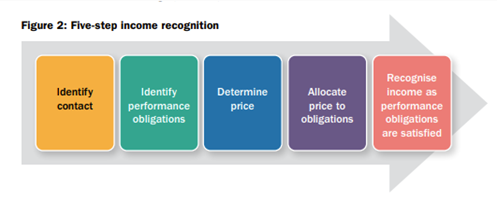
Charities need to review current contracts and income streams and identify both the amount and timing of income using the new 5 step model. Charities will need to consider what records they should keep to support the future preparation of financial statements and how the changes will impact any current borrowing or financial arrangements/covenants or planned future financial arrangements/covenants.
The module also provides guidance on when grant income is income from an exchange transaction or when it is income from a non-exchange transaction.
Recognition of expenses
This module applies in full to all tiers and has now been split with the new model 10A covering provisions, contingent liabilities and contingent assets. There is additional guidance on the treatment of grants with performance-related conditions. The liability and expense arising from grants with performance-related conditions must be recognised to the extent that the recipient of the grant has provided the specified service or goods.
Heritage assets
This module applies in full to all tiers. The main change to this module relates to providing clarity on how to measure the fair value of heritage assets that have been donated. It sets out situations where the fair value cannot be reliably measured and how to set this out in the charity's accounts.
Social investments
This module applies in full to all tiers. Social investments are defined by the NCVO as 'the use of repayable finance to help an organisation to achieve a social purpose'. The rules for accounting for social investments have been updated, to align with the definitions in the SORP and the Charities Act 2011. The terms 'Mixed Motive Investments' and 'Programme Related Investments' have been retired with the new SORP referring only to social investments. There are provisions relating to how social investments should be reported in the trustees' annual report, social investment loans and guarantees made as part of a social investment strategy.
What should charities be doing?
Charities will need to engage with the auditors or accountants to understand the implications for their specific circumstances. However, they may wish to consider taking the following actions:
- Understand the key changes to the Charities SORP and seek advice where necessary.
- Audit the charity's current accounting policies and procedures to identify any gaps against the requirement of SORP.
- Ascertain the charity's tier classification.
- Train trustees (and ensure they appreciate that they are ultimately responsible for compliance) and finance teams on the new requirements.
- Review current lease arrangements.
- Review income streams with the aim of identifying those with performance contracts and identify exchange transactions.
- Apply the five-step model to income from exchange contracts.
- Review the disclosure requirements for the trustees' annual report to ensure that the charity has the information required available for inclusion in the report, including tracking sustainability metrics and stakeholder engagement for ESG reporting.
For more information or advice, please contact Sarah Clune in our Charity Law and Governance team.
Get in touch today
Are you looking for legal services?
Fill out our form to find out how our specialist lawyers can help you.